
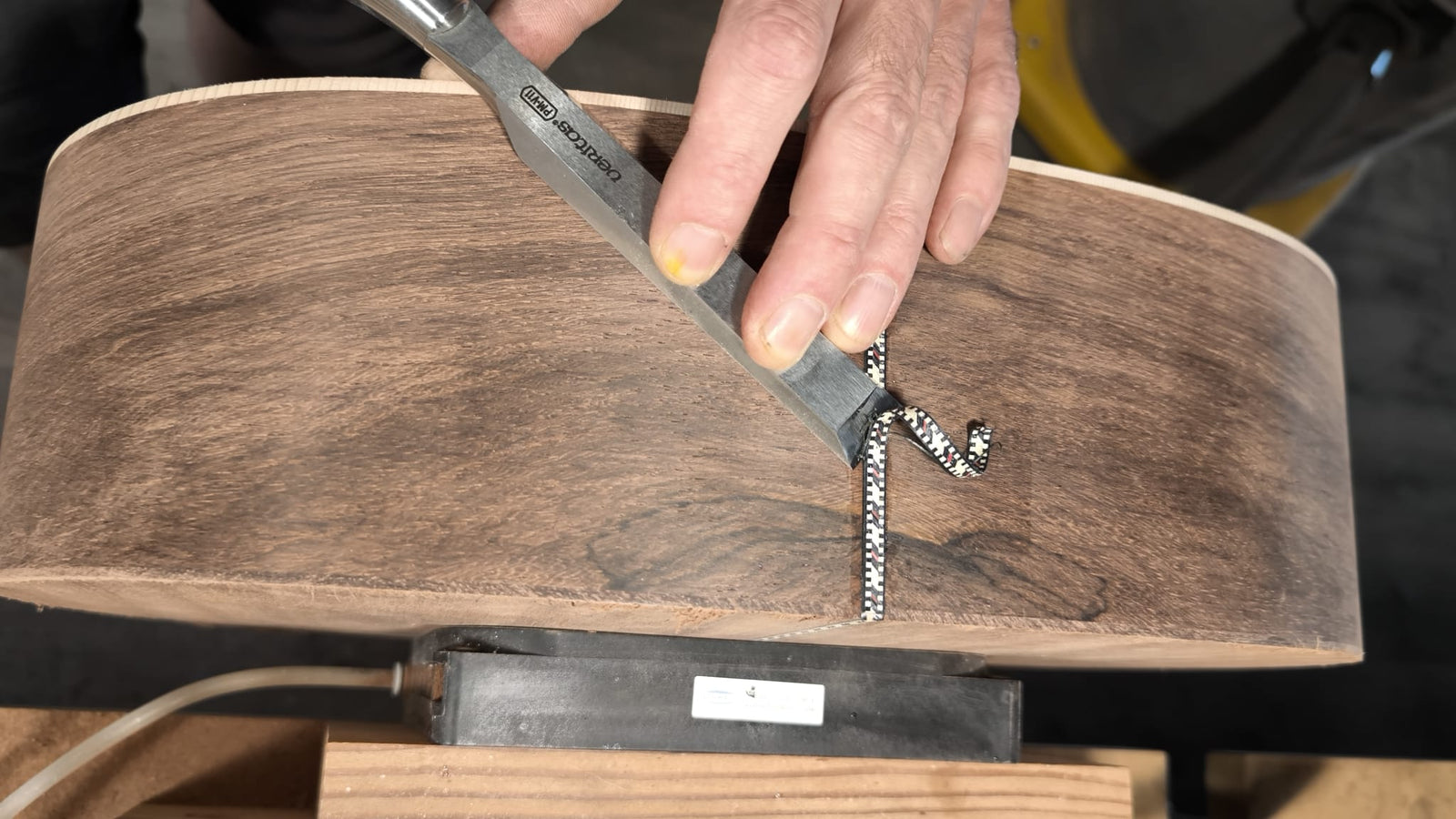
The guitar industry has good reason to be suspicious of artificial intelligence.
We have spent more than 35 years in the musical instrument industry, and we understand why builders, manufacturers and specialist retailers are cautious. This trade depends on judgement, touch, listening, experience and reputation. People do not buy serious instruments because a system generated a passable result. They buy them because skilled people made careful decisions and stood behind the outcome.
That does not mean every form of AI is a threat. It also does not mean every digital tool is AI.
The practical question is simple. Where does technology remove repetitive work and improve decision-making, and where does it start replacing the people whose judgement gives the work its value?
1. Why the guitar industry is suspicious of AI
That suspicion did not appear out of nowhere.
The guitar and musical instrument trade has always relied on authenticity. Makers are judged by what they build, how it sounds, how it feels, how it lasts, and whether their claims can be trusted. Musicians are judged by what they play. Photographers are judged by what they capture. Writers are judged by what they know and how clearly they say it.
Generative AI creates understandable concern because it blurs those lines.
Businesses are now being sold systems that can generate music, images, written content and brand material at speed. Some of that output is presented as if it came from real craft, real experience or real artistic intent. That is where the industry becomes rightly sceptical.
2. Why much of that suspicion is justified
Much of the concern around AI is justified because the problem is not technology itself. The problem is false representation.
We object when AI-generated bands or musicians are presented as real artists.
We object when AI-generated music is passed off as genuine artistic work.
We object when workshop, product or craftsmanship imagery is fabricated.
We object when AI images misrepresent physical products.
We object when low-effort AI content is published without judgement, editing or factual checking.
We object when companies use AI mainly to avoid paying creative professionals.
These are not minor issues. In the guitar industry, trust is commercial infrastructure. Once a brand starts presenting generated material as authentic human work, it weakens its own credibility.
3. The difference between assistance and replacement
We need to be precise here, because many businesses use the term AI far too loosely.
Traditional software and automation are not automatically artificial intelligence. Inventory systems, accounting platforms, ecommerce tools, booking systems, CRM platforms, email rules and automated workflows have existed in one form or another for years. They help a business run properly. That does not make them generative AI.
Generative AI refers to systems that create new text, images, audio or other outputs based on prompts and training data. This is where most of the current concern sits.
AI as an assistive tool can be useful. It can help organise information, summarise material, draft routine admin, analyse patterns and support research. In that role, a person still reviews the work, makes the decisions and remains accountable for the result.
AI as a substitute for human creativity is a different matter. That is where businesses start replacing makers, musicians, photographers, writers or artists with generated output, then pretending the value is unchanged. It is not unchanged.
Our position is straightforward.
Use AI to remove repetitive work, not to remove the people whose judgement and creativity give the work value.
4. Where AI can genuinely help manufacturers and builders
We are not anti-technology. We are against lazy substitution.
There are practical areas where AI may help musical instrument businesses, especially smaller manufacturers and workshops with limited admin capacity.
Useful applications may include:
- Organising product information across specifications, finishes, hardware options and model variations
- Summarising enquiries and communications so teams can respond faster and with more consistency
- Drafting routine administrative material such as follow-up emails, internal notes or standard process documents
- Analysing sales and website data to help identify demand patterns and common customer questions
- Supporting stock forecasting for components, materials and recurring product lines
- Helping small teams research markets and compare categories, competitors or retailer positioning
- Improving customer service through better triage, faster information retrieval and clearer internal handover
- Reducing repetitive office work that takes builders and senior staff away from more valuable work
- Supporting human-led design and engineering analysis through modelling, comparison and scenario testing
This is where AI can be sensible. It can help businesses become more organised, more responsive and less buried in repetitive admin.
That matters because many good manufacturers do not have a technology problem. They have a time problem.
5. Where AI should not replace people
Human judgement must remain central in the areas that define the value of an instrument and the credibility of the brand behind it.
That includes:
- Instrument design
- Voicing and material selection
- Final decisions about tone and feel
- Playing and composing music
- Photography and visual representation of real products
- Brand direction
- Historical interpretation
- Artistic expression
AI can support analysis in some technical areas. It may help model variables, compare options or organise engineering information. We do not deny that. But guitar design and instrument engineering are not solved by calculation alone.
A builder still has to assess the physical result.
A player still has to hear and feel the instrument.
A responsible manufacturer still has to make final decisions and stand behind them.
Modelling may support a builder. It cannot replace physical experience, listening, judgement or accountability.
6. AI-generated music, imagery and false authenticity
This is where the line must stay firm.
If a business is selling handcrafted or carefully manufactured instruments, its presentation has to remain truthful.
That means real products should be shown as they are.
Real workshops should be photographed as they are.
Real musicians should be represented as real musicians.
Real writing should still involve actual knowledge, editing and responsibility.
We do not support AI-generated bands or musicians presented as if they exist. We do not support AI-generated music being dressed up as authentic artistic work. We do not support fake workshop imagery, fake product imagery or generated visuals that misrepresent what a customer will actually receive.
This matters for practical reasons as much as ethical ones. Buyers in the guitar industry often know what they are looking at. They notice when visuals feel artificial. They notice when product details do not make physical sense. They notice when content says a lot without actually knowing the subject.
False authenticity is still false, even when the software output looks polished.
7. A practical principle for businesses adopting AI
Most businesses do not need a grand AI strategy. They need a usable standard.
Here is ours.
Use AI to remove repetitive work, not to remove the people whose judgement and creativity give the work value.
That principle keeps the balance clear.
Use software, automation and assistive AI where they improve organisation, response times, research and administration.
Do not use AI to imitate musicianship, invent craftsmanship, fake imagery, replace creative professionals or publish unchecked material at scale.
If a tool helps your team work better while keeping human responsibility intact, it may be useful.
If a tool exists mainly to replace judgement, reduce truthfulness or cut creative people out of the process, it is moving in the wrong direction.
8. Mammoth Studios' position
Mammoth Studios takes a practical, informed position on AI in the musical instrument industry.
We support technology when it helps manufacturers, retailers and builders run better businesses. We support tools that reduce repetitive office work, improve organisation, strengthen customer service and help smaller teams compete more effectively.
We do not support using AI to replace musicians, artists, photographers, writers or instrument makers.
We do not support generated work being presented as authentic human creativity.
We do not support fake imagery or careless publishing.
The industry does not need panic, and it does not need blind enthusiasm. It needs judgement.
That is the standard we apply in our own work. Mammoth Studios helps musical instrument businesses use technology practically without weakening the authenticity of their products, people or brands.
